
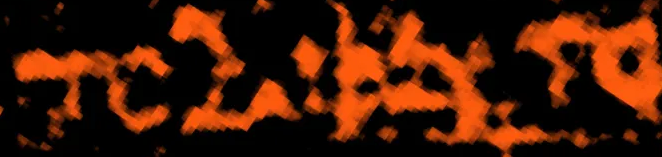
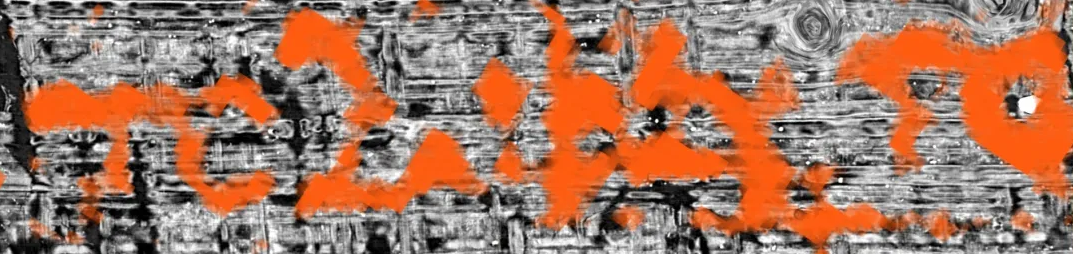
We have found the first eight letters in PHerc0306B, a Herculaneum papyrus scroll carbonized nearly 2,000 years ago. It is the second scroll in which our team has uncovered ink hidden since antiquity. This work builds on our earlier ink discovery in PHerc1447.
The research was carried out by the Grilli Security research team, led by Leonel Wainer and Paulo Sergio Camillo, an independent researcher.
The Vesuvius Challenge’s papyrology lead reported that eight to nine characters were readable.
Reading a carbonized scroll
The Herculaneum scrolls were buried and carbonized by the eruption of Mount Vesuvius in 79 CE. Their survival has made it possible to investigate ancient writing that remained hidden inside them for centuries.
PHerc0306B is held by the Biblioteca Nazionale di Napoli ‘Vittorio Emanuele III’. Its Vesuvius Challenge catalog entry identifies ESRF Grenoble as the source of the X-ray scans that allow us to investigate the scroll without physically unrolling it.
Research carried out through LLMs
We used only LLMs to carry out the computational research and engineering behind our PHerc0306B result.
Why eight letters matter
Our PHerc0306B result did not meet the First Letters Prize requirement of at least ten sufficiently legible letters.
Eight letters give us a specific region of PHerc0306B in which to investigate the surviving writing.
There is also a human reason this matters. Someone once put these marks on papyrus to communicate something. Recovering even a small part of that writing brings us closer to a text that has been inaccessible for centuries.
A technical account is coming
A detailed technical write-up is coming. It will trace the work from PHerc1447 to PHerc0306B and explain our methods, how we used LLMs, and the evidence behind both results.
Grilli Security works in offensive security and frontier AI research. We develop original methods and technologies, and this blog is where we will publish our experiments, findings, and technical accounts for others to examine and build upon.
We are opening this blog with the story of PHerc1447 and the first eight letters we found in PHerc0306B.
Acknowledgments
We thank the Vesuvius Challenge community, the institutions preserving the Herculaneum papyri, and the researchers who made this work possible. Our work uses the Vesuvius Challenge — CT Scans of Herculaneum Papyri dataset and builds on the research and software made available by the community.